Sunday, May 27, 2012

Tourists: Love 'Em or Hate 'Em


It has been a while since I wrote a post for my blog. So Captain Obvious has told me. That doesn’t, however, mean that ideas hadn’t been swirling in my mind about topics. The main one was about resentment for tourists. The thesis went something like this: Real Samoa sucks, tourists suck because they get to live in paradise at the resorts and fall in love with Samoa and fall in love with my boyfriend at the same time. Most likely needless to say, the idea for this post came about after my (ex)boyfriend decided to disappear for two weeks with an old tourist fling of his while leaving me worrying that he was dead. While the major sentiment that tourists suck is probably a little harsh, other ideas I would have thrown into the post held more water, such as the fact that tourists who just lay on the beach at the resorts really don’t get any taste for what Samoa is really like.

However today, I would like to devote this post to a group of tourists who have made me rethink the whole tourists–suck notion. As my time in Samoa winds down, I’ve decided to enjoy this place as much as possible, and yes, that includes behaving like a tourist on the beach. Tossing aside an overrated segue or transition as us literary types like to say, I spent last weekend at Taufua Beach Fales in Lalomanu on the southeast side of my island. It was the third time I’ve gone there and the first in which the other tourists were really cool. (The first time we all went there was for our one year anniversary and at one point a group of tourists told some of the other volunteers that they were acting like college kids on spring break. The second time was our year and a half anniversary and Easter in which a snarky tourist scoffed not-so-quietly under her breath, “Americans” when one of us tried unsuccessfully to give a short goodbye speech to a departing volunteer.) However, third time is cliché-fully a charm. Rachael and I went to Taufua with Emily, her friend from home. Taufua does meals a little non-traditionally with everyone sitting at one long table thus forcing you to talk to other people. Our first night at dinner, we sat next to George and Mel, a Samoan woman with her palagi husband. Funny story about them, I had actually met them briefly in front of a bank in Apia once. It took a little jogging but eventually they remembered me too. Our next stereotype-breaking tourists were Alec and Fanny (pronounced Funny). Alec is from Boston, but lived in New Zealand and Fanny was from Germany. They had eloped fifteen years ago and are now staying at the National University of Samoa for a few months. George, Mel, Alec, Fanny, Rachael, Emily and I had much spirited debate over dinner. Next comes Yanir and Yanadan, two Israelis who had just finished their service in the military. They accompanied the three of us to the To-Sua Sea Trench where the current caused all of us to become quick friends as we were bashed into each other and hands were reached out to save someone from being pulled away, while Tele, our Samoan host/friend, just kept bypassing the ladder and jumping straight into the water. Thanks for the hand Tele.

After we recouped from the trench and after Tele saved a little girl from getting hit by a car, Mika, a fellow volunteer, arrived with his mom from America! Shout out to Emily and Mika’s mom; we love when family visits! Ahem, all of my friends and family: take note.


And finally it’s Gabriel and his parents. (How we didn’t find out their names I have no idea.) Gabriel was a little blonde haired, blue eyed cutie, maybe two or three years old. His mother had been an Australian volunteer in Samoa and she and her husband were married on the beach at Taufua. Gabriel stole everyone’s heart, whether it was playing with Yanir in the water, getting pushed in the kayak by Tele, or just camping out under our fale. This exchange is worthy of being blogged: “Gabriel, I’m going to put on my swimsuit now and then I’ll come out and swim. You just stay here,” Rachael. “I suppose this is really the last age at which this kind of thing is appropriate,” Gabe’s dad. A minute or so passes and Gabe is hunkered down under our beach fale and refuses to come out for anyone.  His dad says, “This is rather a father/son moment, isn’t it? He is literally under a house.” …maybe you had to be there.

Take note, Taufua is a cool place and if you are a tourist, go there and enjoy paradise. Just don’t mess around with the guy I’m dating.

And next time you’re in Samoa, don’t stare at the white girl in the puletasi walking down the street in a village. She’s probably just a Peace Corps volunteer and she won’t smile and wave to you like the little Samoan children.


To-Sua Sea Trench.
The boys jumped from the top of the ladder.
 
Yanir, Yanadan, Emily, Rachael and I hold on for dear life.


Mika and His Lovely Mother

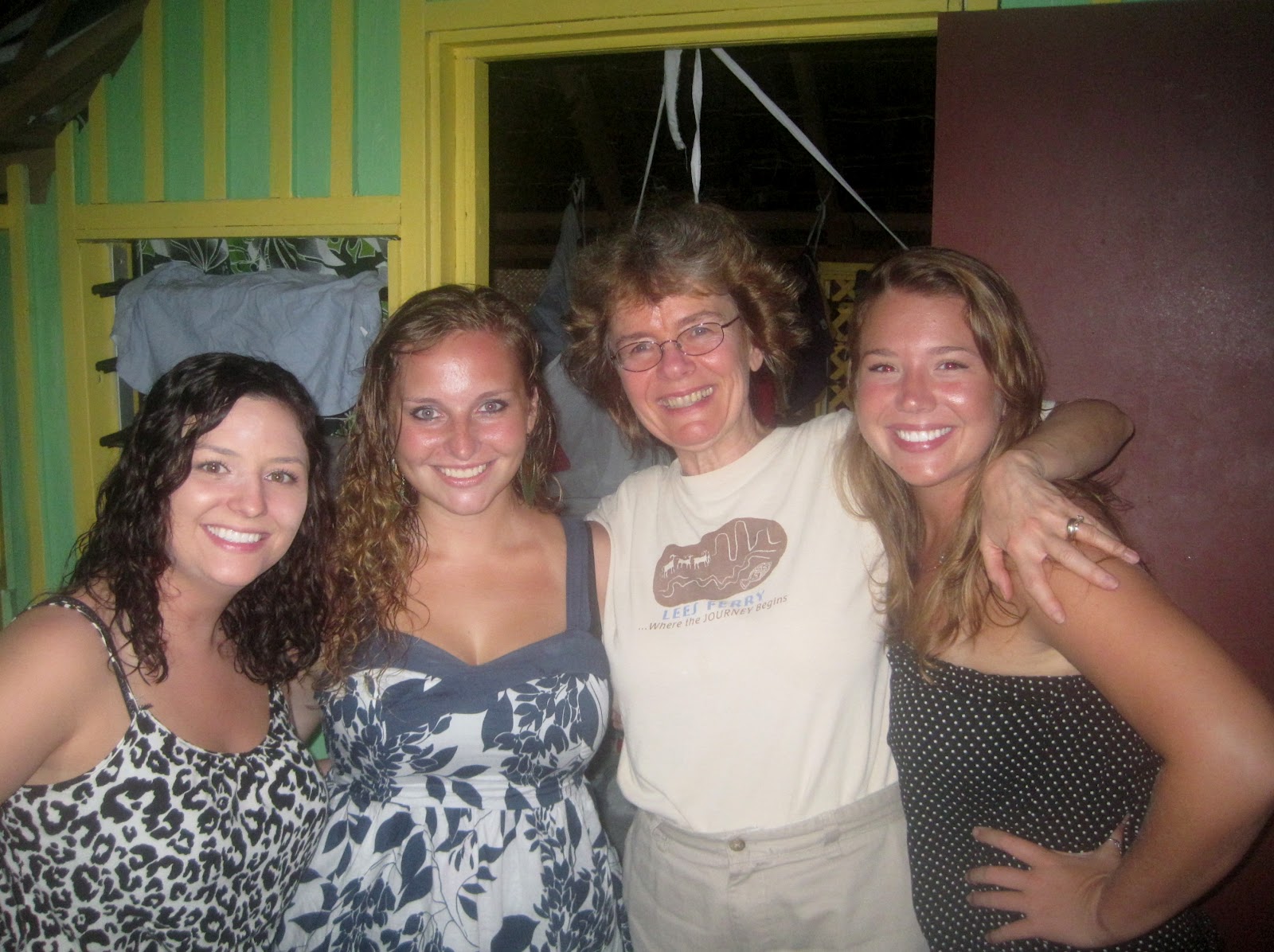
Emily, Me, Mika's Mom, Rachael

Gabriel jamming on his guitar during the Fiafia show.

The boys take a go at Siva Samoa.
Yanir and Yanadan


Gabe's mom is on the far left and Mel is on the far right.
I'm in the middle with awesome hand position.


Yanadan and Alec


Maybe You Really Can't Go Home Again

Sitting around a long table, wearing a wet swim suit modestly covered by a lavalava after an early morning swim, while eating breakfast and discussing the pros and cons of Marmite, a Finnish couple, the man sporting long brown dreadlocks, the woman a meek Scandinavian blonde, laugh when Rachael and I, the two Peace Corps volunteers at the table, say that “we only have six months left.” They scoff, “Only?!”
As I write this, we now have less than six months left on this island, this island that has been both hell and paradise. I’m not sure Dante nor Milton ever visited Samoa, but I think I could add a little to their tales. However, with roughly a week left of the school break, I have already fallen into the don’t-take-this-for-granted stage of my Peace Corps service. Now, instead of marveling over how my ears are being assaulted by someone else’s too-loud music on the bus on the way to Apia, I stare at the ocean waves knowing that this will never happen again. In less than six months it will be November and I will be in Minnesota. Need I say more? Typing this now, sitting beneath my mosquito net, rain drips from my roof and waves crash literally twenty feet from my window. These are the moments. These ones, right now. These are the moments that I will look back on and miss. I have lived through Peace Corps purgatory and Peace Corps Hell and I dare say I have waged battle against Satan herself, but with mere months to go, I can’t let any of the beauty go unnoticed.
With the end bearing down, I can’t help think about after. After Samoa. Six different master’s programs at three different grad schools have my academic mind atwitter. Yet, the excitement that affords and the anticipation of a semi-return to my old life are not what I think about when I think about going home. When you join the Peace Corps you never fathom the goodbyes on the other end. You never expect the pain of saying goodbye here. Good riddance and peace out to some people, but how do you just leave other people who have so influenced your life??? 
Since I came back to Samoa after Christmas my life has been a whirlwind. My host father told me I was a disappointment and he was ashamed of me. Why, I’m sure you all ask? Because I didn’t have relationships with people in the church congregation. Did I mention my host father is the pastor? I was also traveling to other places too much, Savaii in particular. This comment finally made me reveal to him that I was dating a boy, Samoan nonetheless, in Savaii. And cliché enough, he ended up breaking my heart. The details of which I’m sure would have made for great reality television. I was also told in a moment of anger by the person I cared about most in this country (ahem, it might have been that ex-boyfriend) that I was the worst Peace Corps volunteer he had ever known. That moment was perhaps the most ashamed I have ever felt in my life. Being told that you have done nothing for your village, you have had an impact on no one and that what you have done doesn’t matter is not something any Peace Corps volunteer ever wants or imagines of hearing. In a rousing display of her old self, my principal also told me I could only teach for a half an hour a day. Don’t tell her, but I didn’t listen to that. My worthlessness as a volunteer seemingly made clear to me, my year seven girls were there to prove all my skeptics wrong. Not a week goes by where these girls don’t tell me how much they love me, or write me letters, or tell me that they’ll never forget me. It’s for them that I stayed. And it’s for them that I came.
This all being said, blatantly, it will suck when I go home in the fall and the people I care about are here and the thought that I might never see them again and that they’ll be moving on with their lives and will I ever have so much adventure again and was I just another fling-type thing for Tele and maybe something special for a while to Tui but who he hurt anyway? And how will I ever forget either of them? These thoughts tumble in my mind.
And how I don’t know how I’ll move on from Samoa.
How do you say goodbye to something that has had moments of paradise?
I haven’t done much, but I have played a part in some people’s lives. I don’t want to be forgotten either.
What will my life be like when Samoa really is just a memory? When I can’t feel imaginary waves crashing against my legs after a day in the ocean? When I can’t make a sentence in Samoan (not that I'm fluent now)? When my tan lines have completely disappeared? When I don’t find hidden grains of sand in my water bottle? When I can’t text the other volunteers about weekend plans at the beach or at Lusia’s? When I can’t call Samoan friends? When we’ll all be reduced to good old fashioned Facebook stalking?
How do you go back to a life once lived?


Tuesday, February 7, 2012

2012: The Year of Flash Mobs and Slip-n-Slides

As my second and senior year of the Peace Corps starts, I have now experienced roughly fifteen months of Samoan culture. At this point, any good volunteer starts to think, How can I share American culture a little more? The answer comes like a lightning bolt when rain or a dance club is involved.
Twenty mile per hour winds, a pounding rain, and an open porch can only lead to one thing at a Peace Corps volunteer’s house in Samoa. You guessed it: a makeshift, but ever-pleasing Slip-n-Slide**. A sudden and unrelenting rain forced three of my year seven students to take refuge under my porch yesterday afternoon. The fact that they were already soaked didn’t deter them from trying to prevent any further drenching. Ina, Lumepa, Josephine, and I quickly realized that the puddles forming around the edges of my porch were creating a river headed straight for my bedroom door. Most Samoan fales come equipped with stylish blue tarps that can be pulled down to block such river tributaries from forming. We decided to pull mine down. However, my blue Samoan tarp inexperience led to a slight malfunction. Instead of carefully unrolling the tarp which has a piece of lumber nailed to the bottom to hold it down, I just let the tarp drop, causing the wood to rip out of the tarp. The three girls looked at me for a second; their expressions said one of two things: “Wow, Sema, that was dumb,” or, “Oh no, we’re going to get sasa-ed [hit].” My laughter, while outwardly expressing bemusement, was really masking the universal thought for such situations: “Shit.” After jerry-rigging the tarp to stay down with large rocks, the girls discovered that they could run and slide on my soaked porch. You could call it Samoan ice skating. After slipping and sliding around on my plastic-wood ground covering (pisikoas, you know the fake flooring I’m talking about), the girls quickly realized that the falling that is inherent in such a game isn’t so conducive to non-bruised knees. And of course, that’s when the rain stopped and the wind ripped the tarps from under the rocks, which only led me to put the tarp up as quickly as I had taken it down, thus bringing to an end a moment of good ol’ dangerous fun.
I now implore shower-singers and dancers-in-the-dark the world over, what is a Peace Corps volunteer to do during breaks in our Mid-Service Conference except learn a dance called The Wobble? Part of this dance could be likened to a gorilla swinging its lanky arms behind its back. And why wouldn’t we want to do such an ungraceful move in front of numerous Samoans? The answer escapes me. Clearly the new Club X would be the perfect place to perform our monkey-like maneuver. Friday night came and Club X was calling. That’s right Samoa, well, those of you who caught a glimpse of choreography out of the corner of your alcohol-influenced eye and were entertained enough to watch, you just witnessed a flash mob danced by some very coordinated, sweaty white people.
Whether it’s at a night club with semi-inebriated Samoans, some of whom tried to join in with moves of their own, or on my flooded porch, we here at Peace Corps Samoa take every opportunity to share American culture. Any volunteer would now ask, “Can I put this on my VRF?” **

*  For the Slip-n-Slide deprived, this probably overpriced but cheaply manufactured toy is simply a glorified piece of plastic (or trash bag) that is laid on the ground and covered in water. Children, teens, and overzealous fathers then proceed to run onto and semi-gracefully slide the length of the garbage bag, ahem, Slip-n-Slide.

**The VRF, or volunteer report form, is a universal fa’alavelave that every Peace Corps fills out to record what activities you have done in recent months. It also helps volunteers feel like they’re accomplishing something.

Tuesday, January 10, 2012

A Speck on the Map- The Postcard Project

"A nun."

This is the most original answer to the question "What do you want to be when you grow up?" that I've gotten from a Samoan student.

When I've asked students what they want to be when they grow up, most of them don't really have an answer. "A job," is usually their reply. Their bland answers are not due to an English ineficiency. They're just never asked this question. Often one wonders what makes American culture and answers are usually hard to come by since our country is a mosaic of other cultures. However, asking children this question about their future is something very American (if not just very un-Samoan.)

Not only are kids not asked this question, but they often lack the ability to imagine a creative answer because they simply aren't aware of the outside world. When asked if they would ever leave Samoa, a lot of my students say, "No. I want to stay here. In my village." They are also baffled when I tell them I don't know the people on "American Idol."

"But, you live in the same country."
"But it's such a big country!" Then I pull out the world map and try to explain how big the world is. (Poor grammar here, I know.)

One way to give these kids an idea about the rest of the world is the Post Card project. So here's the pitch:
If you read this blog regularly or if you just stumbled upon it, send us a postcard from where you live!!! Write a short message about whatever you want, speak to the students directly or talk about where you live, but make sure the picture on the front shows something about your neck of the woods, as we like to colloquially say here in Minnesota. Write the message in English, but a greeting in the language of your country would be wonderful. (Most likely, I'll use the postcards with my Year 7 class- roughly ages eleven to thirteen.) Address postcards to me:
Samantha Maranell, PCV
Peace Corps
Private Mail Bag
Apia, (Western) Samoa
South Pacific

As postcards come in, we'll put pins on a world map of the places we get postcards from. Let's make these kids a little more worldly.

Literary Recommendations from a Literary Snob

I've been called the literary snob of Peace Corps Samoa and as I gear up to travel back to the island after a rejuvenating Christmas break at home in the USA, I once again find my suitcase with, perhaps, a few too many books. Over the past fifteen months, I've read many a book; here are what I think were the best and the five worst.

The Best:
-Stiff by Mary Roach
-The Unbearable Lightness of Being by Milan Kundera
-Columbine by Dave Cullen
-The Professor and the Madman: A Tale of Murder, Insanity, and the Making of the OED by Simon Winchester
-Everything is Illuminated by Jonathan Safran Foer (You cannot go wrong with this book.)
-The Hunger Games Trilogy by Suzanne Collins
-The short story "Fantasy for Eleven Fingers" by Ben Fountain (Found in the book Brief Encounters with Che Guevara)
-Life of Pi by Yann Martel (!!)
-The Reader by Bernhard Schlink
-Ender's Game by Orson Scott Card
-The Year of Living Biblically: One Man's Humble Quest to Follow the Bible as Literally as Possibly by AJ Jacobs
-Ishmael by Daniel Quinn (!!)
-The Help by Kathryn Stockett (The movie does not do justice to this amazing book; two thumbs down to the movie; two thumbs up to the book.)

The Worst:
-The Girl with the Dragon Tattoo by Stieg Larson (Ok, so it was published posthumously, but wasn't the editor aware that the first and last one hundred pages of the book were completely unnecessary?)
-Water for Elephants by Sara Gruen (The three person love triangle was genious in Sophie's Choice and this book was a sad attempt. Just rent the movie.)
-The Romance Reader's Book Club by Julie L. Cannon (It's as bad as the title implies. You take what you can get when on an island in the middle of the ocean.)
-The Other Side of Haight by James Fadiman (Ken Kesey, if you hadn't had a positive review on the book, I wouldn't have picked this up at all. Damn you Ken Kesey.)
-Sarah's Key by Tatiana de Rosnay (Genocide and Holocaust studies fascinate me, but I really don't see how books that offer nothing new to literature in general or the genre in particular still get published.)

For anyone considering the Peace Corps, here are a few recommendations from the 15 month book list:
-The End of Poverty: Economic Possibilities for Our Time by Jeffrey Sachs (Aid is clearly the answer.)
-The White Man's Burden: Why the West's Efforts to Aid the Rest Have Done So Much Ill and So Little Good by William Easterly (Aid is clearly not the answer.)
-Dead Aid: Why Aid is Not Working and How There is a Better Way for Africa by Dambisa Moyo (Perhaps not the best book on the subject, but one of our Peace Corps staff members said this book "changed her life.")
-American Taboo: A Murder in the Peace Corps by Philip Weiss (The true story of a 1970 murder of a volunteer by another volunteer on the nearby island of Tonga. Face it, it can be dangerous at times. -This book may never have been published; we have an editor's copy going around Samoa. I recommend looking up the case if really interested.)
-Dear Exile: The True Story of Two Friends Separated (For a Year) by an Ocean by Hilary Liftin and Kate Montgomery (This epistolary Peace Corps book is a quick read with many relatable moments.)
-Capitalism: The Unknown Ideal by Ayn Rand (Altruism vs Egoism. Personally, I consider both to be very legitimate reasons for joining the Peace Corps. In fact, if I didn't have egoistic, or selfish, reasons for joining, I might have quit long ago. The cliche is kind of true: I feel like I'm getting more out of it than those I'm supposed to be helping; if I had purely altruisic reasons, why would I have stayed?)
-The forward, introduction, or whatever it was to the book Through Painted Deserts: Light, God, and Beauty on the Open Road by Donald Miller (For anyone who may be hesitant about leaving their pre-Peace Corps comfort zone, this book's forward will motivate you to get out there.)
-Ishmael by Daniel Quinn (This book will make you question everything.)

Thursday, October 6, 2011

365 Days of a Samoan Summer

I write this on the eve of our one year anniversary; when it’ll make it to blog form is unknown. I’m not sure I’m willing to offer any great abstract concepts at the current time about what one year stuck on an island in a foreign culture has taught me. I’ve learned things about myself as well as lost things (or perhaps they’re just dormant for the time being). I’ve wished I hadn’t come here while already knowing what I’ll miss, while already dreading a few goodbyes at the airport, already knowing there will be people I will never see again, but who I will miss for a lifetime.
I’ve been to four of Samoa’s ten islands (Upolu, Savaii, Manono, Namu’a). I’ve tipped a dug-out canoe…twice…by accident. I’ve swum under a freshwater waterfall. I’ve heard the ghosts of Samoa singing under moonlight. I’ve eaten palolo and sea urchin; I’ve declined fruit bat. I’ve been stung by one giant centipede and killed a dozen more. (As I write this, there is a dead giant spider on my windowsill.) My possessions have been gnawed on by rats. I’ve been to the national hospital and three different clinics. I have not gotten typhoid or ghiardia, two of the weight-loss programs Samoa offers. I’ve been to a circus and a hip hop dance competition. I have frequented YNot, VBar, On the Rocks, and EvaEva, but I have yet to step foot in Crabbers. I’ve been proposed to and I’ve climbed a coconut tree (just kidding, the coconut tree is a lie.) I’ve opened a coconut with a machete, strangled a chicken with my bare hand, and failed to weave a palm leaf basket. I’ve been to Samoan fa’alavelaves: weddings, funerals, riding the bus. I’ve been on a bus that broke down and another that blew a tire. I’ve been awoken in the middle of the night by a drunk guy wanting me to come outside (he was then fined $1000 tala by the village –nobody messes with the Peace Corps). I have “gone local,” dating two Samoan boys, one of whom has become my best Samoan friend. I’ve tried to impress people with my Spanish when my Samoan wasn’t good enough. I’ve marched in the Samoan Independence Day parade. I’ve performed the “Hungarian Pastoral Fantasy” by Franz Doppler on national television. I’ve met a Minnesotan who played under Dr. Nimmo. I led the flute section of the National Samoan Orchestra at the Fourth of July celebration at the ambassador’s house. I’ve been very rudely asked to leave the ambassador’s house (some people would call this being kicked out). I’ve learned the dance to “Thriller” with members of the orchestra. I’ve danced a Samoan taupo, a sasa, and a dance to the song “Fa’amalolosi.” I’ve lost a grandmother. I’ve said goodbye to another volunteer. I’ve missed the births of new family members, and the wedding of a cousin. I’ve watched children be hit with hands, rocks, sticks, and pipes. I’ve wanted to hit children. I haven’t hit any children. I’ve read sixty-four books, and watched almost two seasons of “Glee.” I thought I was going to be trampled at the wharf Easter weekend. I have run and jumped off a very high dock numerous times at the legendary Peace Corps hangout of Lucia’s (best stress reliever in Samoa). I requested a village transfer. I’ve been told “You are doing more harm than good.” I’ve been told how pretty I am, that I have cat eyes. I was among the last people on earth to say goodbye to 2010. I had my very first truly snowless Christmas, but my twenty-fourth birthday did not disappoint. I’ve gotten used to everything not going as you expect it to.
Warm showers are a luxury. Bingo paper, no matter what some people do, will never be toilet paper. Ants can and will go everywhere. The mosquito net is your friend. Rain pounding on a tin roof is a sound of relief, of renewal. Brown-bottle Vailima is better than green. The rhyme “I love you, I love you, I love you, I do, but don’t get excited, I love monkeys too,” is always a hit. Teaching every subject in English when half the class doesn’t understand still doesn’t make sense to me. Taro will never be as good as a potato. Always wear blue when Manu Samoa plays. Always. Getting a package or a letter will make any day better. Always clean the leaves out of your yard. Always. McDonalds is a guilty pleasure and the Yacht Club is the best restaurant in the country. Fish and chips is its own food group. Cereal covered in ants is not to be thrown away. The Peace Corps medical manual and kit are saviors. You can never smell too good. You can never have too much phone credit, but don’t let anyone know that. CCK rocks. People you’ve never seen before will know your name and what you had for dinner last night. Everywhere you go there will be someone who knows you. The world is not small; this is just an island. Do whatever you want on Sundays (after you go to church), just don’t let anyone know you aren’t sleeping. People do not eat grubs, contrary to the episode of “Bizarre Foods.” The current season of “Survivor” was filmed on my island. As much and as often as you clean up those little effing millipedes, there will be more in the morning. Mortein will kill cockroaches in a blink and probably an entire country, but it still won’t kill those tiny brown ants. What’s up with that?
And now for my very serious and honest one-year-in advice to Peace Corps prospective. You will not change the world in the Peace Corps. If you’re lucky you might make a difference. You will win no cultural battles; you won’t even be able to begin to fight them. But when it comes to your everyday life, you must never be a push-over. This is an experience unlike any other; it will throw every challenge at you that it can, and more. Survivor Samoa. Who knew?
One year in and I still can’t put my lavalava on right.

Wednesday, August 3, 2011

"Sure Rains a Lot Here"

"Wars throughout history have been waged for conquest and plunder....And that is war in a nutshell. The master class has always declared the wars; the subject class has always fought the battles."

On the eve of leaving the United States and setting out for Samoa with the Peace Corps, all of us wide-eyed frightened little trainees were in a hotel in LA. Also at the hotel was a group of men in one of the military corps. An old man walked up to one of the girls in our group.
     "What are you all here for?"
     "We're leaving for the Peace Corps."
     He offered his hand. "Well, thank you for your service."

Let's face it, the Peace Corps was created by a president facing a war that was just around the corner. We'd all be naive to think Kennedy and Shriver created the Peace Corps just so some hippies could go plant some trees in Peru or teach English in Botswana. This is no Debbie-Do-Gooder mission. After being in the Peace Corps for almost ten months, I've certainly developed new ideas about this government Corps. We are in a battle. A preventative battle. One of the goals of the Peace Corps is to promote an understanding in America of other cultures and in other cultures of America. In short, we're in a subversive mind-battle. Of course, I'm not comparing the Peace Corps to being in war (however, I do think a lot of things soldiers and Peace Corps volunteers go through  culturally are probably similar), but we are providing a service to our country not completely unlike the military corps. As a matter of fact, when we were sworn in, we too had to take the "I will protect the US against enemies foreign and domestic" oath. I think some of the theory in originally creating the Peace Corps was just to put Americans in foreign countries to sort of make friends. Perhaps one day a world leader would say, "Hold up guys. Maybe we shouldn't nuke the US. I had a teacher once who was a Peace Corps volunteer and she was the best teacher I ever had." Bam. War averted. OK, obviously it's not that easy, but you get the idea.

The (perhaps correct) stereotype of Peace Corps volunteers is that we're all "Down with the man" and anti-war. But the joke's on us. The Peace Corps got the type of people who would never volunteer to fight in a war, to do just that. Let's travel back to the opening quote by Eugene Debs. It's no secret that the "elite" often get out of fighting in our wars and often lower-middle and lower class people end up dying in these wars that they can't so easily get out of. The easiest example is that if you were in college during the Vietnam War, you could not get drafted. Well, thinking about that master and subject class idea, where does that put Peace Corps volunteers? As far as I'm concerned we're serving our country too, nonviolently, and with a pen instead of a sword (ten tala to whoever can tell me who said that phrase because I can't remember right now). Unlike those who didn't go to Vietnam because they were getting a college education, one has to h ave a college degree to be in the Peace Corps. Are Peace Corps volunteers perhaps some third category? Not subject class because we had a choice and were not forced to do this out of some sort of necessity, but not master class either because if we were part of this category, we definitely wouldn't be here. But we've got the education of master and perhaps the wherewithal of subject. Maybe the secret is this isn't a subject class fighting a master class' war. Perhaps it is truly just a class of people who believes no class should have to declare or fight a war.

There is a poem written by a soldier during the Vietnam War that I consistently come back to when considering my current Samoan experience:

APO 96225 by Larry Rottmann

A young man once went off to war in a far country,
and when he had time, he wrote home and said,
“Dear Mom, sure rains a lot here.”

But his mother — reading between the lines as mothers
always do — wrote back,
“We’re quite concerned. Tell us what it’s really like.”

And the young man responded,
“Wow! You ought to see the funny monkeys.”

To which the mother replied,
“Don’t hold back. How is it there?”

And the young man wrote,
“The sunsets here are spectacular!”

In her next letter, the mother pleaded,
“Son, we want you to tell us everything. Everything!”

So the next time he wrote, the young man said,
“Today I killed a man. Yesterday, I helped drop napalm
on women and children.”

And the father wrote right back,
“Please don’t write such depressing letters. You’re
upsetting your mother.”

So, after a while,
the young man wrote,
“Dear Mom, sure rains here a lot.”


Imagine this next bit as a cute little footnote:
Here is another tricky thing the Peace Corps accomplishes with us. It's no secret that a lot of volunteers meet their future spouse in their country of service. But here's something probably lesser well-known. If a volunteer gets pregnant by a host-country national during her two years of service and decides to keep the baby, she is sent back to the US where she will give birth; she also cannot finish her two years of service. (You can also not get married while in service.) So this half-American, half-host country baby has conveniently been born in the US, which grants it US citizenship, but not dual citizenship. So this baby can only legally have loyalty to the US. Now say a volunteer in Samoa goes back home to have her half-American, half-Samoan baby and sixteen or so years later, there's a war in American Samoa as Samoan warriors threaten their lives (think "Boy Meets World" when Cory, Shawn, and Topanga are no that quiz show and get speared by Samoans for every wrong answer). Well, naturally America w2ould step in and this little child has to fight with American Samoa and try to kill his half-brother who grew up in Samoa. (Like the Civil War, pitting brother against brother.) Oh, tricky, tricky Peace Corps.  (If some of my logistics are wrong, at least this is only a footnote.)